
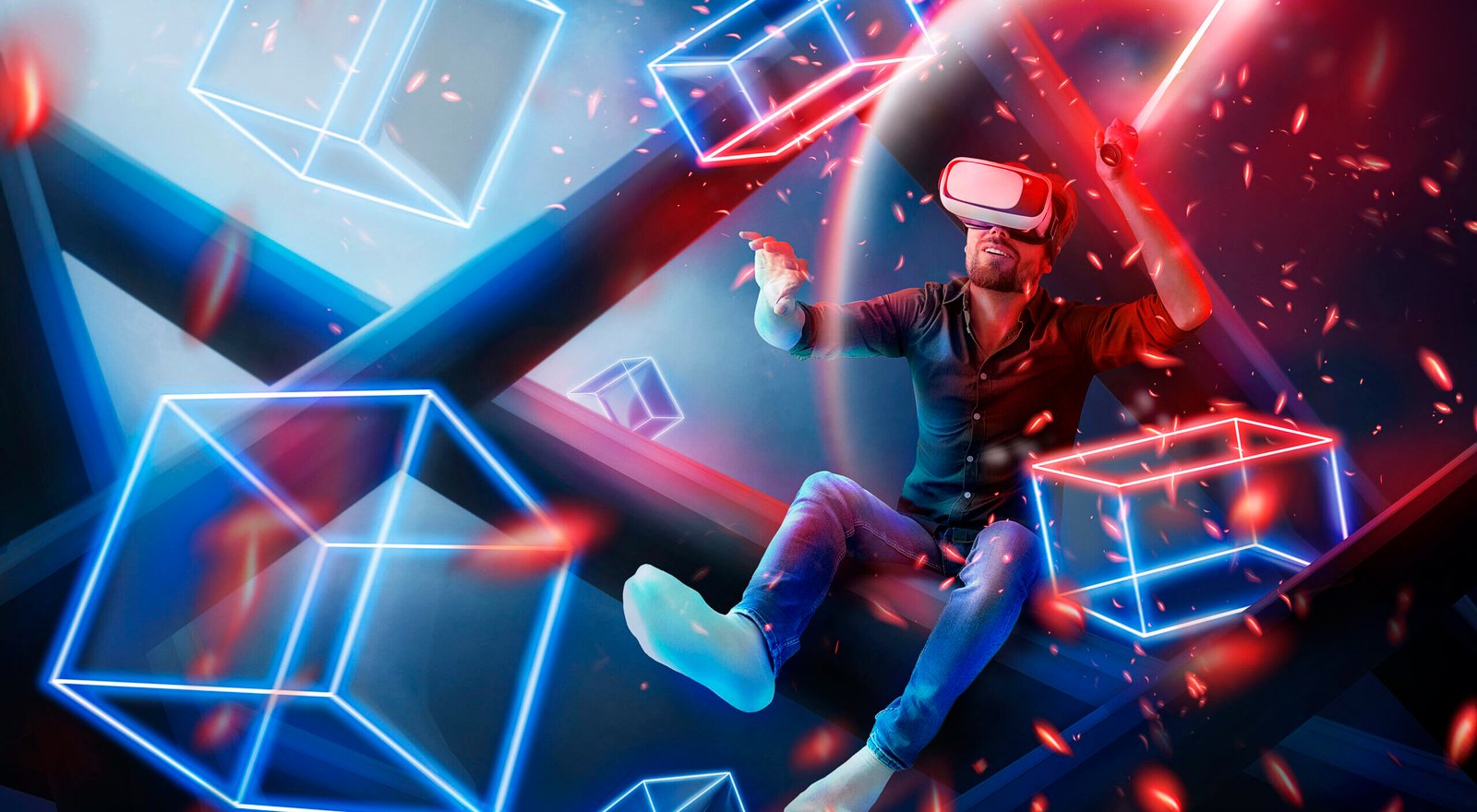
Virtual Reality: Redefining Human Experience in the Digital Age
Virtual Reality (VR) has rapidly evolved from a futuristic concept into one of the most exciting and transformative technologies of our time. What once existed only in science fiction is now reshaping how we learn, work, play, and connect. From immersive gaming to medical simulations and virtual classrooms, VR is changing not just what we see—but how we experience reality itself.
- What Is Virtual Reality?
Virtual Reality is a simulated digital environment that allows users to experience a three-dimensional world as if they were physically present within it. Using special headsets, motion controllers, and sometimes haptic feedback devices, VR immerses the senses—sight, sound, and touch—creating an experience that feels remarkably real.
Unlike traditional screens or 2D media, VR gives users freedom to move around, interact, and explore. You don’t just watch a scene—you’re inside it. Whether it’s standing on the surface of Mars, diving deep into the ocean, or walking through an architectural model that hasn’t yet been built, VR transforms imagination into a tangible experience.
- How Virtual Reality Works
At its core, VR combines advanced computer graphics, motion tracking, and sensory feedback to create immersion.
Head-Mounted Displays (HMDs): Devices like Meta Quest, HTC Vive, or PlayStation VR contain screens and sensors that display stereoscopic images—slightly different for each eye—to simulate depth.
Motion Tracking: Sensors detect head, hand, and sometimes full-body movements, adjusting the environment accordingly so users can look, reach, and walk naturally.
Haptic Feedback: Gloves, suits, or controllers vibrate or apply gentle pressure to simulate the feeling of touch.
Spatial Audio: 3D sound systems adjust sound direction and intensity based on where the user turns or moves, enhancing realism.
These elements work together to trick the brain into believing the digital world is physically real.
- The Evolution of Virtual Reality
The roots of VR go back decades, but the technology truly accelerated in the 21st century.
1960s–1980s: Early prototypes like the Sensorama and the first head-mounted displays explored immersive visuals but were bulky and expensive.
1990s: Gaming companies experimented with VR, but limited processing power and poor graphics prevented mass adoption.
2010s: The launch of modern headsets such as Oculus Rift revolutionized accessibility. Powerful smartphones and GPUs made VR faster, lighter, and more affordable.
Today: VR is no longer confined to entertainment—it’s deeply integrated into education, healthcare, real estate, training, and social communication.
Each generation of VR technology has moved closer to the ultimate goal: complete presence—the feeling that the virtual world is indistinguishable from the physical one.
- Applications of Virtual Reality
VR’s potential extends far beyond gaming. It is reshaping industries, enhancing productivity, and transforming human creativity.
A. Education and Training
Virtual Reality makes learning an experience instead of a task. Students can explore ancient civilizations, dissect virtual organisms, or perform complex chemistry experiments safely.
In professional training, pilots, surgeons, and firefighters use VR simulations to practice high-risk scenarios without danger. The result: better skills, improved confidence, and safer real-world outcomes.
B. Healthcare
VR is revolutionizing medicine—from surgical planning to mental health therapy.
Surgical Training: Doctors can rehearse operations using patient-specific 3D models.
Pain Management: Patients undergoing treatment can use VR environments to distract from pain and reduce stress.
Therapy and Rehabilitation: VR helps patients regain mobility, manage anxiety, and treat phobias through controlled virtual environments.
C. Architecture and Real Estate
Architects and designers can walk clients through digital building models before a single brick is laid. Homebuyers can tour properties remotely, exploring rooms and layouts in 3D. This makes design more collaborative and eliminates costly revisions.
D. Business and Collaboration
Virtual meetings are evolving from video calls into 3D spaces where teams can brainstorm, manipulate virtual objects, and interact as avatars. Remote work feels more human and interactive when participants share the same virtual workspace.
E. Tourism and Culture
With VR, users can travel the world without leaving home—standing before the Eiffel Tower, visiting museums, or walking ancient ruins in lifelike clarity. For cultural preservation, VR recreates historical sites that may no longer exist physically.
F. Entertainment and Gaming
Gaming remains VR’s most visible frontier. Immersive storytelling and realistic mechanics allow players to physically duck, grab, and move through dynamic worlds. Movies, concerts, and sports broadcasts are also experimenting with VR for a front-row, 360-degree experience.
- The Impact on Human Experience
What makes VR so powerful isn’t just technology—it’s emotion. It changes how we perceive distance, presence, and empathy.
Empathy and Awareness: Experiencing situations through someone else’s perspective—such as living with a disability or witnessing global crises—helps build understanding and compassion.
Memory and Learning: Studies show that immersive experiences enhance memory retention and comprehension.
Creativity: Artists, architects, and designers use VR as a new canvas for imagination—sculpting and painting in 3D spaces without physical constraints.
Virtual Reality doesn’t just simulate the world—it can also expand it, allowing us to experience things beyond human limitation.
- Challenges and Limitations
Despite rapid progress, VR still faces several challenges.
A. Hardware Costs and Accessibility
High-quality VR systems remain expensive, limiting widespread use. However, prices are gradually dropping as technology advances.
B. Motion Sickness
Some users experience dizziness or discomfort when their movement in VR doesn’t match their physical motion. Improving frame rates and reducing latency can minimize this issue.
C. Content Development
Creating immersive VR experiences requires specialized skills in 3D design, coding, and storytelling. Many industries are still building the necessary creative ecosystems.
D. Privacy and Safety
As VR becomes more social and connected, data privacy and user safety are growing concerns. Developers must ensure that virtual environments are as secure as real ones.
- The Future of Virtual Reality
The future of VR is bright—and fast approaching.
Mixed and Extended Reality (XR): The line between physical and digital worlds will blur even more as VR merges with Augmented Reality (AR) and Mixed Reality (MR).
Full Sensory Immersion: Future VR systems will simulate touch, temperature, and even scent, creating total immersion.
AI Integration: Artificial intelligence will personalize VR environments, adapting experiences to user behavior and emotion.
Virtual Economies: As digital spaces evolve, virtual goods, real-estate, and services will drive new forms of commerce in the metaverse.
Healthcare Revolution: VR combined with AI will support diagnosis, therapy, and patient education in ways never before possible.
The ultimate goal of VR is not escape—but expansion: expanding human potential, knowledge, creativity, and empathy.
- Virtual Reality and the Human Connection
Interestingly, VR is not just about technology—it’s about people. By removing physical barriers, VR allows humans to connect in ways that feel real and emotional. Friends across continents can share a concert together; doctors can collaborate from different hospitals; teachers can guide students inside virtual labs.
The irony of Virtual Reality is that it doesn’t make the world less real—it makes the digital world more human.
- Conclusion
Virtual Reality is no longer a distant dream—it’s the next evolution of human experience. It redefines how we work, learn, and interact by merging imagination with technology.
As VR becomes more accessible, immersive, and intelligent, it will transform nearly every industry and reshape how people perceive reality itself. The boundary between the physical and digital worlds will continue to fade, opening a new chapter in human history—one where we can explore not just the world around us, but worlds of our own creation.